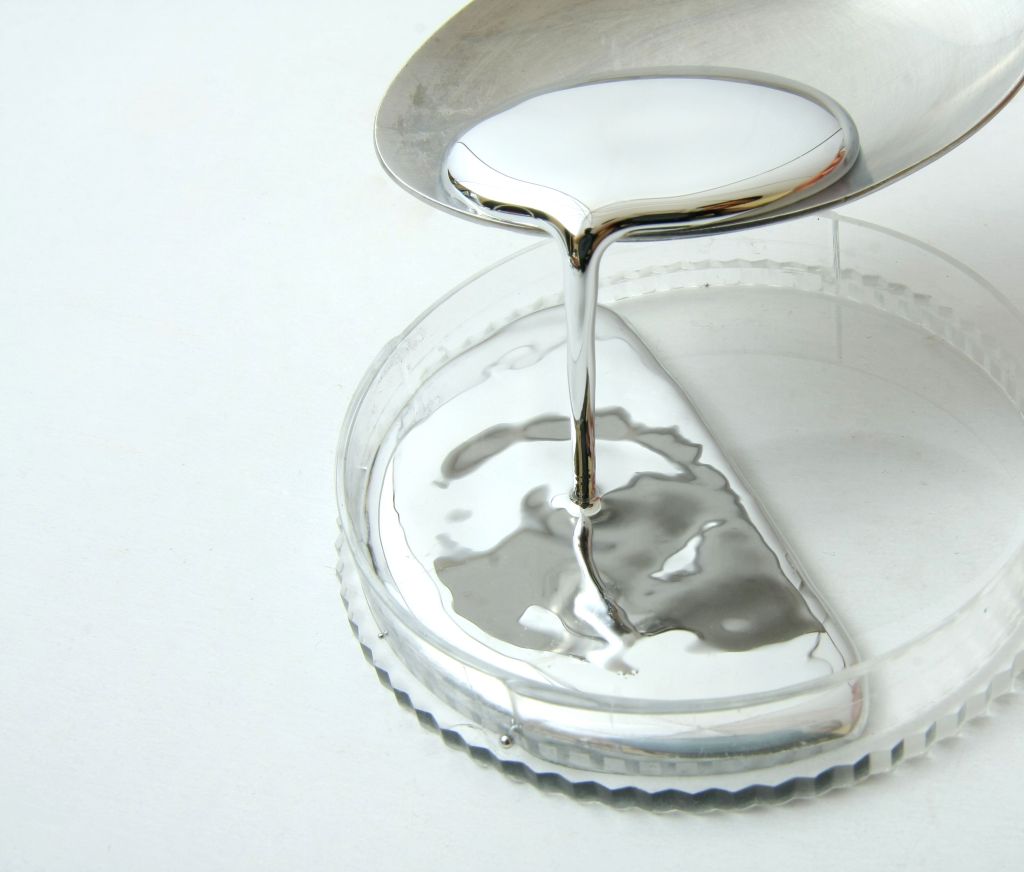
Mercury is a chemical element with the symbol Hg and atomic number 80. It is commonly known as quicksilver and was formerly named hydrargyrum.
Mercury is the only metal that is a liquid at standard temperature and pressure. The only other liquid element under standard conditions is bromine (a halogen), although the metals rubidium, cesium, and gallium melt at a temperature just above room temperature. … Mercury is a very rare element in the Earth’s crust.
Life processes | Key Terms and its Meaning | Class-10 Biology
Nutrition :- Process of taking in and utilizing various types of foods by organisms, for obtaining energy necessary for growth and development.
Autotrophs :- Organisms who can synthesize their own organic food from simple inorganic sources.
Heterotrophs :- Organisms that cannot prepare its own food and depends upon other for its nutritional requirements.
Enzymes :- These are the biological catalyst that speed up various biochemical reactions.CarbohydratesBiological molecule made up of sugar or glucose, required for the production of energy.
Chlorophyll :- Pigments found in green plants essential for the process of photosynthesis. They are located inside the thylakoid of the chloroplast.
Starch :- These are storage form of glucose in plants.GlycogenThese are storage form of glucose in animals.
Photosynthesis :- It refers to the process of synthesis of food by autotrophic organisms by utilizing carbon dioxide and water in the presence of chlorophyll that absorbs the sunlight.
Why mercury is considered a metal rather than being liquid in normal room temperature.
Mercury
Answer:-
Key Points
Mercury is the only metal that is liquid at standard conditions for temperature and pressure.
Mercury is a poor conductor of heat, but a fair conductor of electricity.
Mercury has a unique electron configuration which strongly resists removal of an electron, making it behave similarly to noble gas elements. As a result, mercury forms weak bonds and is a liquid at room temperature.
Mercury dissolves to form amalgams with gold, zinc, and many other metals.
Basically, it’s because mercury is bad at sharing—electrons, that is.Most metal atoms readily share valence electrons with other atoms. The electrons in a mercury atom are bound more tightly than usual to the nucleus. In fact, the s electrons are moving so fast and close to the nucleus that they exhibit relativistic effects, behaving as if they were more massive than slower-moving electrons. It takes very little heat to overcome the weak binding between mercury atoms. Because of the behavior of the valence electrons , mercury has a low melting point, is a poor electrical and thermal conductor, and doesn’t form diatomic mercury molecules in the gas phase.
Class 10 is the most important year for any student, as it is a crucial milestone that will set them on the path to achieving their future academic goals. To successfully clear the first Board exams of their lives, students need a solid understanding of theory as well as practical knowledge. That’s why we’re here to help you every step.
This is why CBSE concept has designed and see you and other case based questions for you of class 10th very efficiently and carefully so must read all the the study material available on our site.
Human Eye and Colourful World
INTEXT QUESTIONS
Q1. What is meant by power of accommodation of the eye?
Ans. When the ciliary muscles are relaxed, the eye lens becomes thin, the focal length increases, and the distant objects are clearly visible to the eyes. To see the nearby objects clearly, the ciliary muscles contract making the eye lens thicker. Thus, the focal length of the eye lens decreases and the nearby objects become visible to the eyes. Hence, the human eye lens is able to adjust its focal length to view both distant and nearby objects on the retina. This ability is called the power of accommodation of the eyes.
Q2. A person with a myopic eye cannot see objects beyond 1.2 m distinctly. What should be the type of the corrective lens used to restore proper vision?
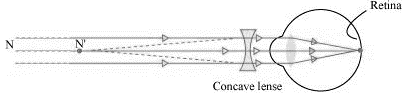
Ans. The person is able to see nearby objects clearly, but he is unable to see objects beyond 1.2 m. This happens because the image of an object beyond 1.2 m is formed in front of the retina and not at the retina, as shown in the given figure.
To correct this defect of vision, he must use a concave lens. The concave lens will bring the image back to the retina as shown in the given figure.
Q3. What is the far point and near point of the human eye with normal vision?
Ans. The near point of the eye is the minimum distance of the object from the eye, which can be seen distinctly without strain. For a normal human eye, this distance is 25 cm. The far point of the eye is the maximum distance to which the eye can see the objects clearly. The far point of the normal human eye is infinity.
Q4. A student has difficulty reading the blackboard while sitting in the last row. What could be the defect the child is suffering from? How can it be corrected?
Ans. A student has difficulty in reading the blackboard while sitting in the last row. It shows that he is unable to see distant objects clearly. He is suffering from myopia. This defect can be corrected by using a concave lens.
Human Eye and Colourful World Class 10 MCQs Questions with Answers
Question 1. A person cannot see distinctly objects kept beyond 2 m. This defect can be corrected by using lens of power (a) +0.5 D (b) -0.5 D (c) +0.2 D (d) -0.2 D
Answer :-(B) -0. 5d
Question 2. A student sitting on the last bench can read the letters written on the blackboard but is not able to read / the letters written in his textbook. Which of the following statements is correct? (a) The near point of his eyes has receded away. (b) The near point of his eyes has come closer to him. (c) The far point of his eyes has come closer to him. (d) The far point of his eyes has receded away.
Answer :-(a) The near point of his eyes has receded away.
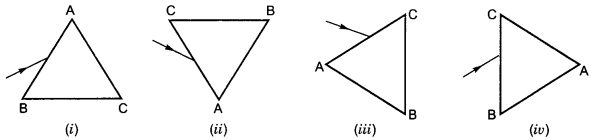
Question 3. A prism ABC (with BC as base) is placed in different orientations. A narrow beam of white light is incident on the prism as shown in the Figures given below. In which of the following cases, after dispersion, the third colour from the top corresponds to the colour of the sky?
(a) (i) (b) (ii) (c) (iii) (d) (iv)
Answer :-(B)
Question 4. The change in focal length of human eye is caused due to – A. Ciliary muscles B. Pupil C. Cornea D. Iris
Answer:- A. Ciliary muscles
Question for You – The phenomenon of light responsible for the working of human eye is : A. Reflection B. Refraction C. Power of accommodation D. Persistence of vision
The ratio between the speed of light in medium to speed in a vacuum is the refractive index. When light travels in a medium other than the vacuum, the atoms of that medium continually absorb and re-emit the particles of light, slowing down the speed light. In this article, let us discuss the refractive index of water and various mediums.
Where,
n is the refractive index
c is the velocity of light in a vacuum ( 3 × 10⁸ m/s)
v is the velocity of light in a substance
The vacuum has a refractive index of 1. The refractive index of other materials can be calculated from the above equation. Higher the refractive index, the higher the optical density and slower is the speed of light. The table below lists the refractive index of different media.
Material
Refractive Index
Air1.0003
Water
1.333
Diamond2.417
Ice1.3
Ethyl Alcohol
1.36
The refractive index of glass ng is 1.52 and refractive index of water nw is 1.33. Since the refractive index of glass is higher than the water, the speed of light in water is faster than the speed of light through glass. If the refractive index of a medium is greater than that of another, then the first medium is said to be optically denser. Most of the substances we know have a positive refractive index having value more than zero. The material will have a negative refractive index when it has negative permittivity and permeability.
The refractive index provides a measure of the relative speed of light in different media. Knowing the refractive indices of different media helps the student to identify the direction in which way the light would bend while passing from one medium to another.
Why is high refractive index important for optical polymers?
Optical polymers with high refractive index allow light rays to bend more within the material, which helps in lowering the profile of the lens. Also, as the refractive index increases, the thickness of the lens decreases, resulting in less weight.
What is refractive index gradient?
The refractive index gradient is defined as the rate of change of refractive index with respect to distance in the material. Distance refers to the slope of the refractive index profile at any point.
The refractive index gradient is expressed in terms of reciprocal of a unit of distance.
An example of a refractive index gradient is the rate of change of refractive index at any point with respect to distance.
The refractive index gradient is a vector point function.
1.The hottest planet in the solar system? (a) Mercury (b) Venus (c) Mars (d) Jupiter
2.Amravati, Bhavani, Hemavati and Kabini are tributaries of which one of the following rivers? (a)Mahanadi (b) Godawari (c) Cauvery (d) Krishna
3.Which of the following is related to Bharat Nirman Scheme? (a) Foodgrain production self sufficiency (b) Family welfare programme (c) Infrastructure development (d) Employment generation program
4. Which peninsular river is least seasonal in flow? (a) Narmada (b) Krishna (c) Godavari (d) Cauvery
5. Which one of the following ports is the oldest port in India? (a) Mumbai Port (b) Chennai Port (c) Kolkata Port (d) Vishakhapatnam Port
6. At which one of the following places do the rivers Alaknanda and Bhagirathi merge to form Ganga? (a) Devprayag (b) Rudra Prayag (c) Karnaprayag (d) Vishnuprayag
Give reason for the following: (a) School bells are made up of metals. (b) Electric wires are made up of copper. Answer. (a) It is because metals are sonorous, i.e. they produce sound when struk with a hard substance. (b) It-is because copper is good conductor of electricity.
Directions (Q1-Q2): Based on the alphanumeric series given below, answer the following questions:
Alphanumeric Series: W % ^ K V P 1 I 7 E 0 & 2 9 A F Z N 4 * @ U ? M
Q 1. How many numbers in the series are preceded by a vowel?
Four None Two One Three Answer: (3) Two; 7 is preceded by I and 0 is preceded by E.
Q 2. What is the second element from the right of 7th element from left?
K V 1 7 ? Answer: (4) 7; the Seventh element from left is 1 and 2nd element to the right of 1 is 7
Q 3. From a certain point, Smriti walks 70 m towards the south. Then, she turns to her right & starts walking straight for another 70 m. Then, again turning to her left he walks for 60 m. She then turns to her left & walks for 70 m. How far is she from the starting point?
120 m 135 m 140 m 130 m 125 m Answer: (4) 130 m; 70+60 = 130 m
Logical Reasoning – Direction Test
Q 4. In a row of persons, the position of Sakshi from the left side of the row is 26th and position of Sakshi from the right side of the row is 35th. Find the total number of students in the row?


 CBSE CONCEPTS