Indicators: Indicators are substances which indicate the acidic or basic nature of the solution by the colour change.
Types of indicator
There are many types of indicators. Some common types of indicators are:-
Natural Indicators: Indicators obtained from natural sources are called Natural Indicators. Litmus, turmeric, red cabbage, China rose, etc., are some common natural indicators used widely to show the acidic or basic character of substances.
Litmus
Litmus is obtained from lichens. The solution of litmus is purple in colour. Litmus paper comes in two colours- blue and red.
An acid turns blue litmus paper red.
A base turns red litmus paper blue
Red cabbage
The juice of red cabbage is originally purple in colour. Juice of red cabbage turns reddish with acid and turns greenish with base.
Olfactory indicators
Substances which change their smell when mixed with acid or base are known as Olfactory Indicators. For example; Onion, vanilla etc.
Synthetic indicators
Indicators that are synthesized in the laboratory are known as Synthetic Indicators. For example; Phenolphthalein, methyl orange, etc.
Acids: Acids are sour in taste, turn blue litmus red, and dissolve in water to release H+ ions.
Example: Sulphuric acid (H2SO4), Acetic Acid (CH3COOH), Nitric Acid (HNO3) etc.
Properties of Acids:
- Acids have a sour taste.
- Turns blue litmus red.
- Acid solution conducts electricity.
- Release H+ ions in aqueous solution.
Types of Acids: Acids are divided into two types on the basis of their occurrence i.e., Natural acids and Mineral acids.
Natural Indicators
Acids which are obtained from natural sources are called Natural Acids or Organic Acids.
Example
- methanoic acid
- acetic acid
- citric acid
Mineral acids
Acids that are prepared from minerals are known as Mineral Acids Example; Inorganic acids, man-made acids or synthetic acid are also known as Mineral Acids.
Example:
Hydrochloric acid (HCl)
Sulphuric acid (H2SO4)
Nitric acid (HNO3)
Carbonic acid (H2CO3)
Phosphoric acid (H3PO4) etc.
Test for hydrogen gas
The gas evolved after reaction of acid with metal can be tested by bringing a lighted candle near it. If the gas bums with a pop sound, then it confirms the evolution of hydrogen gas. Burning with pop sound is the characteristic test for hydrogen gas.
Reactions of acid with metal carbonate
Acids give carbon dioxide gas and respective salts along with water when they react with metal carbonates.
Metal carbonate + Acid → Salt + Carbon dioxide + Water
Examples:
Hydrochloric acid gives carbon dioxide gas, sodium chloride along with water when reacts with sodium carbonate.
Reaction of acid with metal hydrogen carbonate (Bicarbonate)
Acids give carbon dioxide gas, respective salt and water when they react with metal hydrogen carbonate.
Acid + Metal hydrogen carbonate → Salt + Carbon dioxide + Water
Test For Evolution of Carbon Dioxide Gas: Carbon dioxide turns lime water milky when passed through it. This is the characteristic test for carbon dioxide gas.
The gas evolved because of reaction of the acid with metal carbonate or metal hydrogen carbonate turns lime water milky. This shows that the gas is carbon dioxide gas.
Acids
Strong Acids
An acid which is completely ionised in water and produces (H+) is called Strong Acid.
Examples: Hydrochloric acid (HCl), Sulphuric acid (H2SO4), Nitric acid (HNO3)
Weak Acids
An acid which is partially ionised in water and thus produces a small amount of hydrogen ions (H+) is called a Weak Acid.
Example: Acetic acid (CH3COOH), Carbonic acid (H2CO3)
Bases: Bases are bitter in taste, have soapy touch, turn red litmus blue and give hydroxide ions (OH–) in aqueous solution.
Examples: Sodium hydroxide (caustic soda) – NaOH
Properties of Bases:
- Have a bitter taste.
- Soapy to touch.
- Turns red litmus blue.
- Conducts electricity in solution.
- Release OH– ions in Aqueous Solution
Types of bases
Bases can be divided in two types – Water soluble and Water-insoluble.
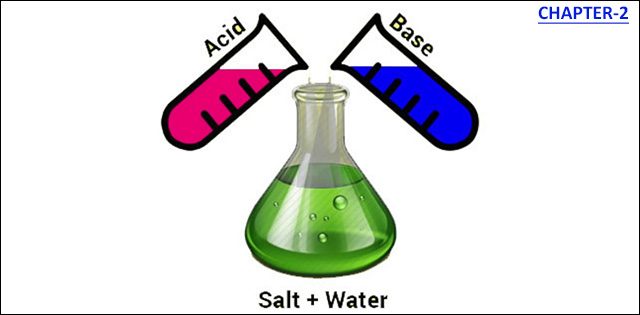
Neutralisation Reaction: An acid neutralizes a base when they react with each other and respective salt and water are formed.
Acid + Base → Salt + Water
Dilution of Acid and Base: The concentration of hydrogen ion in an acid and hydroxide ion in a base, per unit volume, shows the concentration of acid or base.
;
 CBSE CONCEPTS